Droplyst / Independent product / iOS
A set, saved in order.
An app that recognizes the music around you and turns a listening session into a playlist.
Built with
- Application
- TypeScript
- React Native
- Expo
- Expo Router
- Native audio
- ShazamKit
- react-native-apple-shazamkit
- Expo Audio
- Data & sessions
- Supabase
- PostgreSQL
- Supabase Auth
- Music integration
- Spotify Web API
- OAuth 2.0
- Expo AuthSession
- Device storage
- Expo SecureStore
- Build & release
- EAS Build
- EAS Submit
- TypeScript compiler
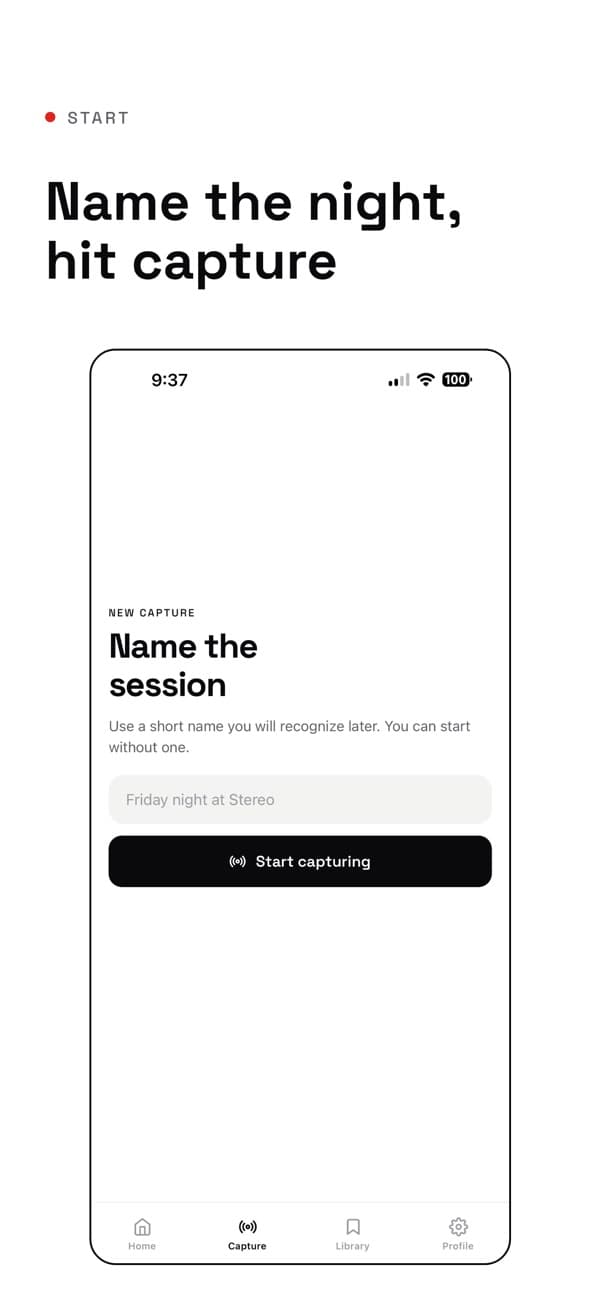
Original App Store screenshots.
My contribution
I built and shipped the app, from song recognition and session storage to playlist export and the iOS release.
Under the surface
The engineering.
ShazamKit can recognize the same song several times. Droplyst filters those repeated matches, keeps the first detection in session order and looks up the recording in Spotify for export.
Listen
Native ShazamKit events, with a timed fallback.
Resolve identity
Check recording IDs and normalized artist/title.
Keep the sequence
Append new matches to the session timeline.
Export
Resolve Spotify tracks and report unmatched entries.
Decision / 01
One song can arrive under several identities.
Consecutive recognition windows can return the same recording. A resumed session also needs to remember what it already captured.
The capture loop checks a shared set of keys: Shazam ID, ISRC and a lowercased title/artist pair. Any matching key suppresses the duplicate; a new result registers all available keys. Continuing a saved session rebuilds that set from its tracks, including any Spotify IDs already resolved.
The text fallback catches matches with missing IDs, but identical artist/title metadata can collapse different versions. Deduplication applies across the session, so an intentional replay of the same song is also suppressed. This favors a clean playlist over a complete performance log.
Decision / 02
Pause has to stop the work behind the screen.
Native recognition can finish after a user pauses or leaves capture. Without lifecycle handling, a late callback could append a track to a stopped session.
The native adapter exposes continuous match/error events when available. Stopping removes subscriptions and guards callbacks. The fallback races recognition against cancellation and a 15-second timeout, then releases the native listener in a finally block. Returning to the foreground restarts capture for an active, unpaused session.
This adds native lifecycle code beyond the React interface. Continuous capture and the timed fallback have separate paths to maintain and device interruptions still need testing on real hardware.
Decision / 03
Recognized does not mean available on Spotify.
Shazam and Spotify use different catalog identities. A successful recognition cannot be treated as a successful playlist addition.
Spotify resolution tries the recording’s ISRC first, then searches by title and artist. Results are resolved in session order and sent in batches of up to 100 URIs. Export returns a result for each track plus added and not-found counts. Concurrent token refresh requests share one in-flight promise.
The text fallback accepts the first search result, so it can choose a different version. Sequential resolution keeps ordering straightforward but takes longer for large sessions. Export status is explicit rather than assuming every detected track transferred.
Edge cases
What happens when…
- The same Shazam ID arrives again
- Suppress the duplicate even if its displayed metadata changes.
- Capture resumes on an existing session
- Seed the identity set from saved tracks before listening again.
- A track has no Spotify match
- Keep its session entry and report it as not found in the export result.
A closer look.
Select a step to inspect the behavior.
Select a recognition
Saved session
1 saved · First matches, in order.
Existing ISRC → suppress duplicate
Recognized twice. Saved once.
Any known identity is enough to suppress a duplicate. Even if the display title changes, a matching Shazam ID or ISRC keeps the result from being appended again.
Fraq
Property operations software spanning assignment, housekeeping and maintenance.